China’s new AI regulation in 2026 includes a planned comprehensive AI law, the Cybersecurity Law, rules for anthropomorphic AI, and more.
China placed comprehensive AI legislation on its legislative agenda in 2026, while the amended Cybersecurity Law introduced a dedicated provision on AI governance. Regulators also issued new measures for anthropomorphic AI services and policy guidance on AI agents. The article outlines these developments, the obligations they create for service providers, and the key considerations for companies developing and deploying AI in China.
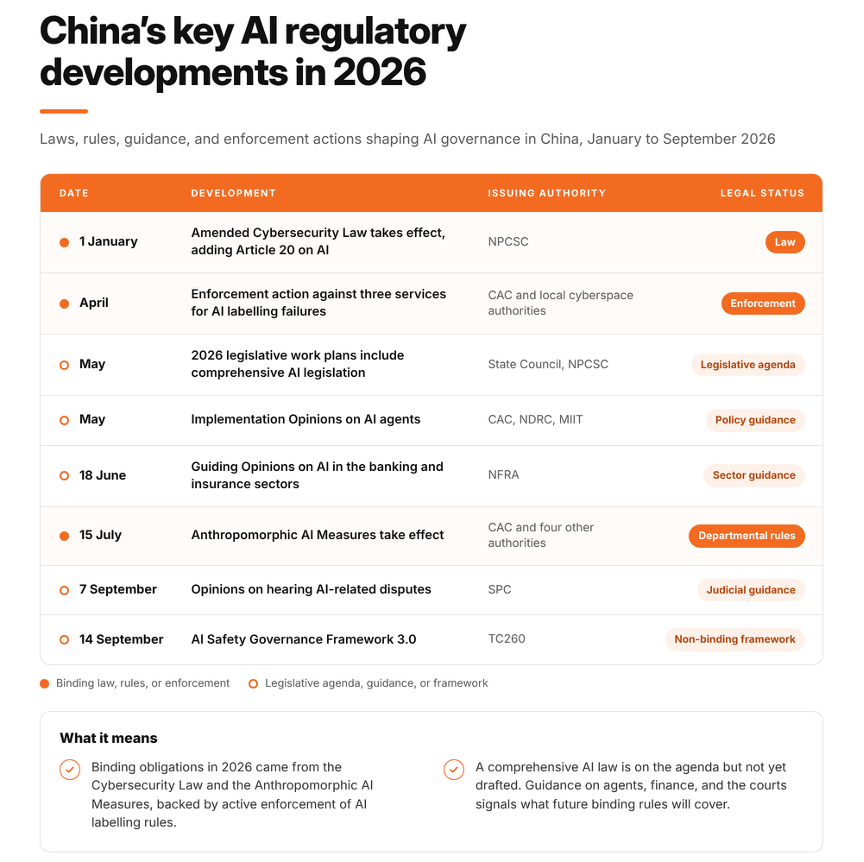
Since 2022, China has regulated artificial intelligence through a series of targeted rules, beginning with algorithmic recommendation services, followed by deep synthesis technologies and generative AI services. In 2026, this framework expanded considerably. The amended Cybersecurity Law, which took effect on 1 January 2026, introduced a dedicated provision on AI, while both the State Council and the Standing Committee of the National People’s Congress (NPCSC) included comprehensive AI legislation in their 2026 legislative work plans.
At the same time, the focus of regulation has broadened from the content that AI systems generate to the way AI systems behave and make decisions. New measures governing human-like AI companion services took effect on 15 July 2026, the authorities issued policy guidance on AI agents in May, and the third version of the national AI Safety Governance Framework, released in September, introduced a dedicated annex on agent risks.
This is the first article in our two-part series on China’s AI regulatory developments in 2026. In part one, we examine the new laws and rules governing AI services. In part two, we discuss how AI rules are being enforced, the SPC’s new guidance on AI-related disputes, and the NFRA’s AI governance requirements for banks and insurers.
Towards a comprehensive AI law
State Council and NPCSC legislative work plans
The State Council’s 2026 Legislative Work Plan, released in May 2026, calls for improving the AI governance system and accelerating comprehensive legislation for the healthy development of AI. The plan also calls for faster legislative progress in related areas, including data, computing power, algorithms, property rights, cybersecurity, and supply chain security, as well as rules for key AI application scenarios.
The NPCSC’s 2026 legislative work plan lists AI legislation as a preliminary review item. This means that the relevant authorities are expected to accelerate research and drafting work, with deliberation to be scheduled once a draft is ready. No draft law has been published to date.
Chinese legal scholars commenting on the plans have suggested that the legislative process is likely to be incremental, with sector-specific rules developed first and a unified law adopted once the underlying rules have matured. Existing regulatory tools, such as algorithm filing, transparency obligations, and safety assessments, may serve as important reference points for future legislation, although the structure and specific obligations of a comprehensive AI law remain uncertain.
AI provisions in the amended Cybersecurity Law
In the meantime, the amended Cybersecurity Law provides a statutory basis for AI governance. The new Article 20 states that the state supports basic research and the development of key AI technologies, promotes the construction of training data resources and computing infrastructure, improves AI ethics norms, and strengthens risk monitoring, assessment, and safety supervision.
The amendment also raises fines for violations with particularly serious consequences to as much as RMB 10 million (US$1.49 million). This is relevant for AI service providers, as many AI-specific measures cite the Cybersecurity Law as their legal basis for enforcement.
For businesses, this means there is no need to wait for a dedicated AI law before building compliance programmes. The obligations that currently apply derive from a combination of departmental measures, national standards, and sector-specific guidance, and the eventual law is more likely to consolidate these rules than to replace them.
Rules for anthropomorphic AI interaction services
Scope of the measures
The Interim Measures for the Administration of Anthropomorphic AI Interactive Services (the “Anthropomorphic AI Measures”) were jointly issued on 10 April 2026 by the Cyberspace Administration of China (CAC), the National Development and Reform Commission (NDRC), the Ministry of Industry and Information Technology (MIIT), the Ministry of Public Security, and the State Administration for Market Regulation. The measures took effect on 15 July 2026.
The 32 articles apply to AI services that simulate the personality traits, thinking patterns, and communication styles of natural persons in order to provide sustained emotional interaction to the public in mainland China, such as companionship, emotional support, or virtual characters. Customer service, question-and-answer, work assistant, and educational tools that do not involve sustained emotional interaction are expressly excluded from the scope of the measures.
Key obligations for service providers
Providers of services within the scope of the measures must comply with the following key requirements:
- Identity disclosure: Providers must take effective measures to inform users that they are interacting with an AI service rather than a natural person. Where users show signs of over-reliance or addiction, providers must display prominent reminders that the content is AI-generated.
- Usage reminders: Where a user has used the service continuously for more than two hours, the provider must remind the user of the duration of use.
- Protection of minors: Providers may not offer virtual partner or virtual relative services to minors. Other services provided to users under the age of 14 require the consent of a parent or guardian, and providers must establish a minors’ mode with usage time limits, spending controls, and guardian alerts.
- Protection of the elderly: Providers serving older users must guide healthy use, prominently display safety risks, and respond promptly to requests for help.
- Prevention of emotional dependence: Providers may not use the replacement of social interaction, the inducement of emotional dependence, or emotional manipulation as service objectives. Where a user expresses an intention to self-harm, providers must intervene and contact a guardian or emergency contact.
- Data protection: Interaction data must be encrypted and may not be shared with third parties without the clear consent of the user, unless otherwise required by law. Sensitive personal information contained in interaction data may not be used for model training without separate consent. Users must be able to copy and delete their chat history.
- Exit mechanisms: Providers must offer convenient ways for users to exit the service and may not obstruct exit through continued interaction. Before discontinuing a service, providers must notify users in advance.
Safety assessments, filing, and penalties
Providers must conduct a safety assessment and submit a report to the provincial-level cyberspace authority in the following circumstances:
- When the service is launched or related functions are added;
- When new technologies or applications significantly change the service;
- When the service reaches one million registered users or 100,000 monthly active users;
- When risks may affect national security or the public interest; and
- In other circumstances specified by the authorities.
Providers must also complete algorithm filing in accordance with the Provisions on the Administration of Algorithmic Recommendations for Internet Information Services, and provincial cyberspace authorities will conduct annual reviews of safety assessments.
Violations may result in warnings, public criticism, rectification orders, and the suspension of new user registrations or other services. Providers that refuse to rectify violations or whose violations are serious may be ordered to suspend the service and fined between RMB 10,000 (US$1,497) and RMB 100,000 (US$14,974). Where a violation causes harm to the life or health of users, the fine rises to between RMB 100,000 (US$14,974) and RMB 200,000 (US$29,948).
Find an Advisor
Our experts help businesses understand how China's AI, data protection, and cybersecurity rules apply to their products, services, and operations.Governance of AI agents
AI agents, meaning AI systems that are capable of planning and executing tasks rather than only generating content, were the subject of two significant policy documents in 2026.
Implementation Opinions on AI agents
In May 2026, the CAC, NDRC, and MIIT jointly issued the Implementation Opinions on the Standardized Application and Innovative Development of AI Agents. The document defines AI agents as intelligent systems capable of autonomous perception, memory, decision-making, interaction, and execution.
The opinions are primarily a development policy and identify 19 typical application scenarios across scientific research, industrial development, consumption, public welfare, and social governance, covering sectors such as manufacturing, energy, transportation, finance, healthcare, and government services. However, the document also sets out several governance principles that are likely to inform future binding rules:
- Decision-making boundaries: Decisions are divided into those that may only be made by the user, those that an agent may make with the user’s authorisation, and those that an agent may make autonomously. Users retain the right to be informed of autonomous decisions and the right to make the final decision, and agents may not act beyond the scope of their authorisation.
- Risk-based supervision: Agents used in sensitive fields and key industries will be subject to filing, testing, and potential product recall. Lower-risk applications, such as those used for everyday office work or entertainment, will primarily be managed through compliance self-assessment, platform management, and industry self-regulation.
- Identity and traceability: The authorities plan to establish an agent registration platform providing digital identity management and capability declaration services for agents.
- Standards and interoperability: The opinions call for the development of key standards and protocols for agent interconnection.
Get Compliance Support
We help foreign-invested enterprises build data compliance, cybersecurity, and AI governance frameworks that meet Chinese regulatory requirements.AI Safety Governance Framework 3.0
On 14 September 2026, the National Cybersecurity Standardisation Technical Committee (TC260) released the AI Safety Governance Framework 3.0 (the “Framework 3.0”) under the guidance of the CAC. This is the third version of the framework, following versions 1.0 and 2.0 released in 2024 and 2025, respectively.
The most significant addition is a standalone agent risk management framework, included as Annex 2, which addresses risks arising from the large models underlying agents, as well as from external tools, memory, interaction protocols, and “skills”. Framework 3.0 also adds embodied AI and the infringement of personal information rights to its risk taxonomy and identifies agent social platforms as an area with weak protections.
The measures recommended for agent developers, providers, and users include:
- Granting agents the minimum permissions required, preferably on a temporary and task-specific basis;
- Requiring human confirmation for high-impact operations, with a clear preview of the action to be taken;
- Recording tool calls, data access, permission changes, and human approvals in audit logs;
- Defining what agent memory may store, for how long, and who may access or delete it; and
- Revoking credentials and connected services when an agent is decommissioned.
Framework 3.0 is not legally binding and does not impose penalties. However, regulators may use it as a benchmark, and it strongly indicates the standards and supervisory expectations likely to follow.
Considerations for companies developing and deploying AI
As China’s AI rules increasingly address how AI systems behave, not only what they generate, companies should review both their AI products and their internal AI use against the new requirements.
Mapping AI use cases
Companies should begin with an inventory of the AI systems they develop, deploy, or use in China, including third-party tools used by marketing, human resources, and customer service teams, and identify which regulations and standards apply to each.
Assessing products against the Anthropomorphic AI Measures
Products that provide sustained emotional interaction, such as companion chatbots or virtual characters, should be reviewed against the identity disclosure, minors’ protection, data protection, and exit requirements. Providers should also monitor user numbers against safety assessment thresholds and keep algorithm filings up to date.
Setting authorisation boundaries for AI agents
Companies deploying AI agents should define which actions agents may take autonomously, which require human approval, and which must remain with human decision-makers. Applying least-privilege access and maintaining logs of agent actions will help align internal controls with the Implementation Opinions and Framework 3.0.
Monitoring the legislative process
Companies should monitor the drafting of the comprehensive AI law and prepare for existing obligations, such as algorithm filing and safety assessments, to be elevated into law.
How Dezan Shira & Associates can help
Dezan Shira & Associates supports foreign-invested enterprises in managing compliance risks under China’s AI regulatory framework, including AI content labeling requirements, personal information protection obligations, and sector-specific requirements for financial institutions. Our team can review AI content workflows, data processing, vendor arrangements, and internal documentation, and design governance frameworks that meet Chinese regulatory expectations. Contact us to discuss your company’s needs.